
Introduction
Every four years Americans participate in one of the most important rituals of self-government: choosing a president. Or do we?
Have you ever wondered why we vote the way we do? Why presidential campaigns seem to focus on certain states while largely ignoring others? Have you ever asked yourself whether your vote carries the same weight as someone else? These questions point to a simple reality: the United States does not elect its president through a direct national popular vote. Instead, Americans vote through a system designed more than two centuries ago by men confronting a very different set of political challenges than we face today. That raises an even more interesting question.
Why would the founders of a nation born from a revolution against monarchy and dedicated to the principles of liberty and self-government intentionally create a system that seems less democratic than a direct popular vote? The truth is that Americans do not directly elect their president. In fact, they never have. Instead, we vote for electors who then cast the votes that officially determine who occupies the White House. The result is a system where a candidate can win the presidency without winning the most votes, where some states receive enormous campaign attention while others are largely ignored, and where the value of a vote can vary depending on where a citizen lives. For many Americans, this raises an obvious question:
Why?
The answer is more complicated than most modern political debates suggest.
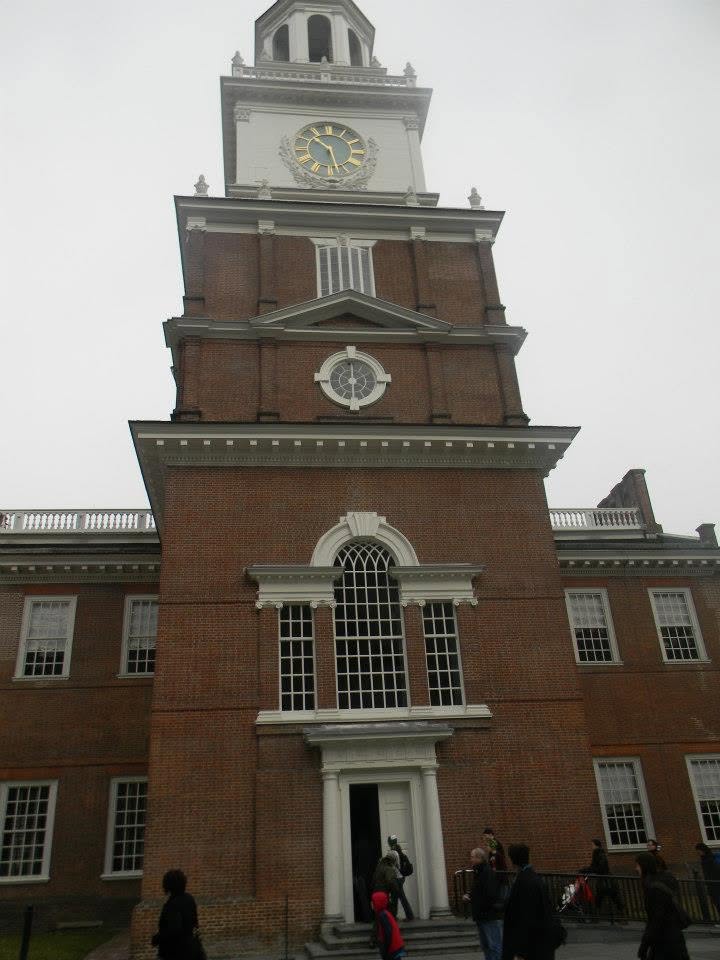
The men who gathered in Philadelphia in 1787 were not trying to create the most democratic government possible. They were trying to create a government that would survive. They feared concentrated power. They feared mob rule. They feared regional conflict. They feared foreign influence. They feared the collapse of the fragile union they had only recently secured through war. They disagreed sharply about how much power ordinary citizens should exercise directly, how much authority should remain with the states, and how a president could remain independent from Congress while still being accountable to the public. Complicating all of this was a question the nation had not yet resolved and would eventually fight a civil war over: slavery.
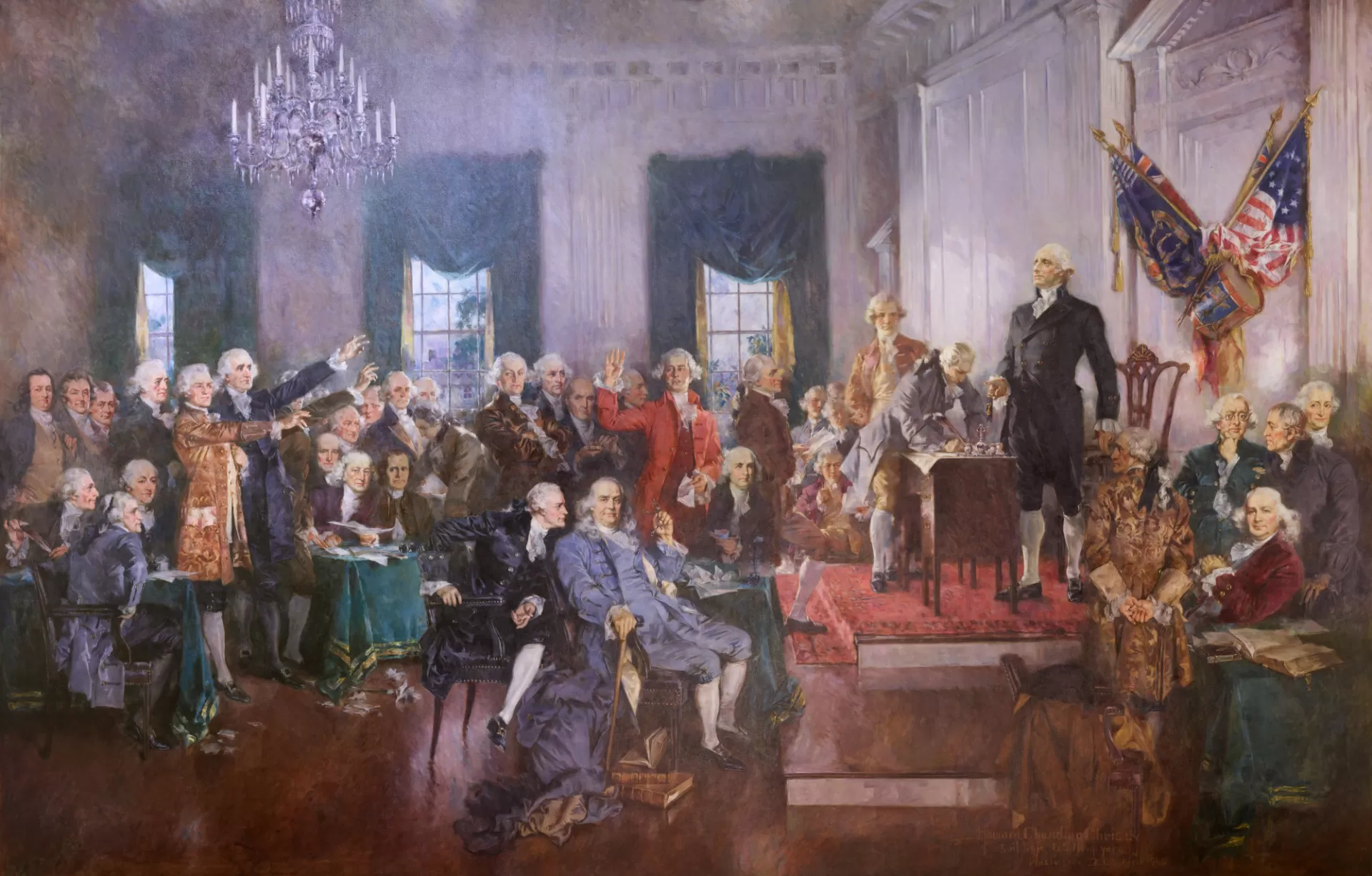
The Electoral College emerged from these competing interests and competing fears. It was not the product of a single principle. It was a compromise between democracy and federalism, between popular participation and elite judgment, between national unity and regional power. This debate rages in American politics even today. Understanding that compromise requires us to confront a larger truth about American history.
The United States has always proclaimed lofty ideals. Liberty. Equality. Self-government. Yet throughout much of its history, access to those ideals was limited to a relatively small portion of the population. Over the next two centuries Americans would repeatedly expand the circle of people included in the nation's promises: former slaves, women, racial minorities, immigrants, and countless others who demanded access to rights that earlier generations often reserved for themselves. The story of the Electoral College is, in many ways, part of that larger journey.
It is the story of a nation attempting to balance its ideals against competing interests, practical realities, and political incentives. It is the story of how institutions are created, how they evolve, and how each generation decides whether they still serve the purpose for which they were designed. Before deciding whether the Electoral College should be preserved, reformed, or abolished, we should first understand why it exists at all.
Part I The Problem – Choosing a President in 1787
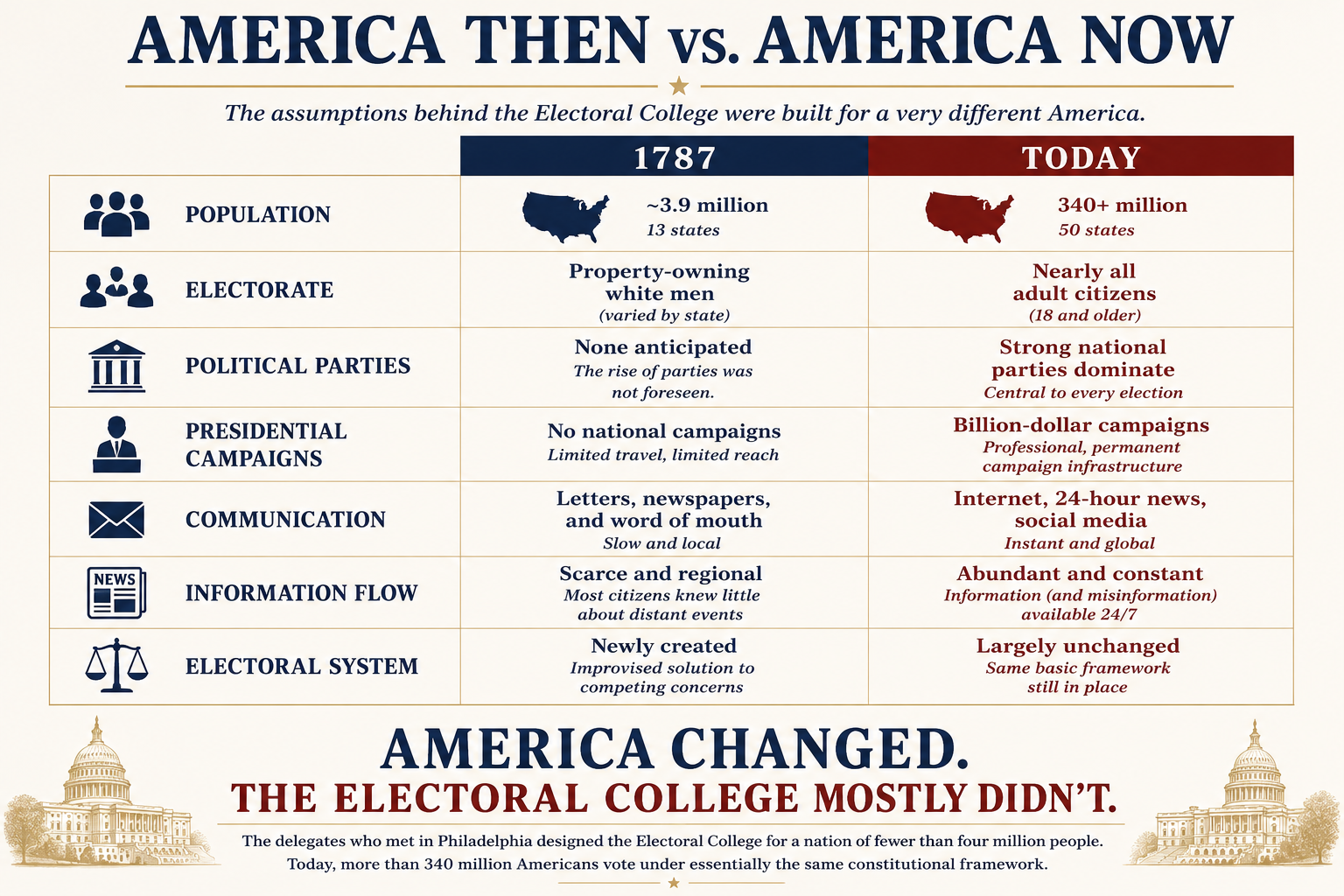
To understand why the Electoral College exists, we must first understand the problem facing the delegates gathered in Philadelphia during the summer of 1787. Modern Americans often view presidential elections through the lens of today's world. We live in a nation connected by highways, airplanes, television, and the internet. Information travels across the globe in seconds. Candidates can communicate directly with millions of voters through television appearances, social media, and online advertising. It is easy to assume that a direct national election is the obvious and natural way to choose a president. For the delegates at the Constitutional Convention, however, nothing was obvious.
The United States was a young and fragile nation. The Revolution had ended only a few years earlier. The government established under the Articles of Confederation had proven weak and ineffective, and was struggling to meet the needs of the young nation. The Articles had been designed during the Revolutionary War, when many Americans feared creating a central government that might resemble the British system they had just fought to escape. As a result, the national government possessed very limited authority. It could not directly tax citizens, regulate interstate commerce, or effectively enforce many of its own decisions.
Congress lacked the authority to address many of the nation's problems, interstate disputes threatened unity, and events such as Shays' Rebellion convinced many leaders that the republic itself might not survive without significant reforms. The delegates who would eventually end up in Philadelphia knew something needed to change. While they had been sent to revise the Articles of Confederation, what they ultimately did was far more radical. The delegates who gathered in Philadelphia in 1787 were therefore not simply debating how to create a new government. They were responding to the perceived failures of the one they already had. They would gather to create an entirely new government, a Constitution. And these delegates were not simply writing a Constitution either. They were attempting to preserve an experiment in self-government that many believed could easily fail. One of the most difficult questions they faced was how to select a chief executive. At first glance, the answer seems simple: let the people choose. Yet for many delegates, direct election raised serious concerns. The United States of 1787 was not the United States of today. Travel was slow. News traveled slowly. Most citizens knew little about political leaders outside their own states. In 1787, traveling the roughly 300 miles between Boston and Philadelphia by horseback or stagecoach typically took between ten and fourteen days. Today, that same journey can be completed in about six hours by car. Information moved no faster than the people carrying it.
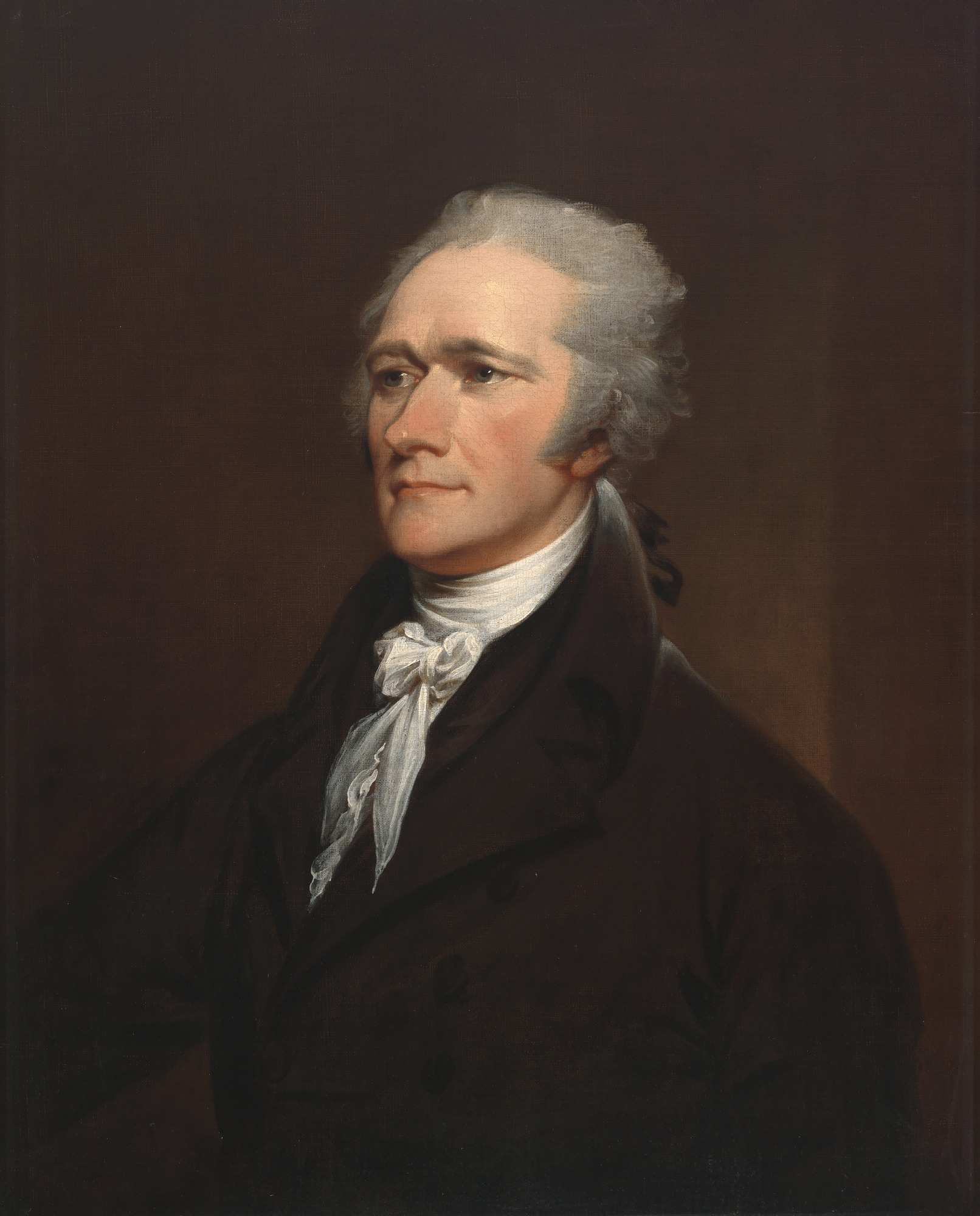
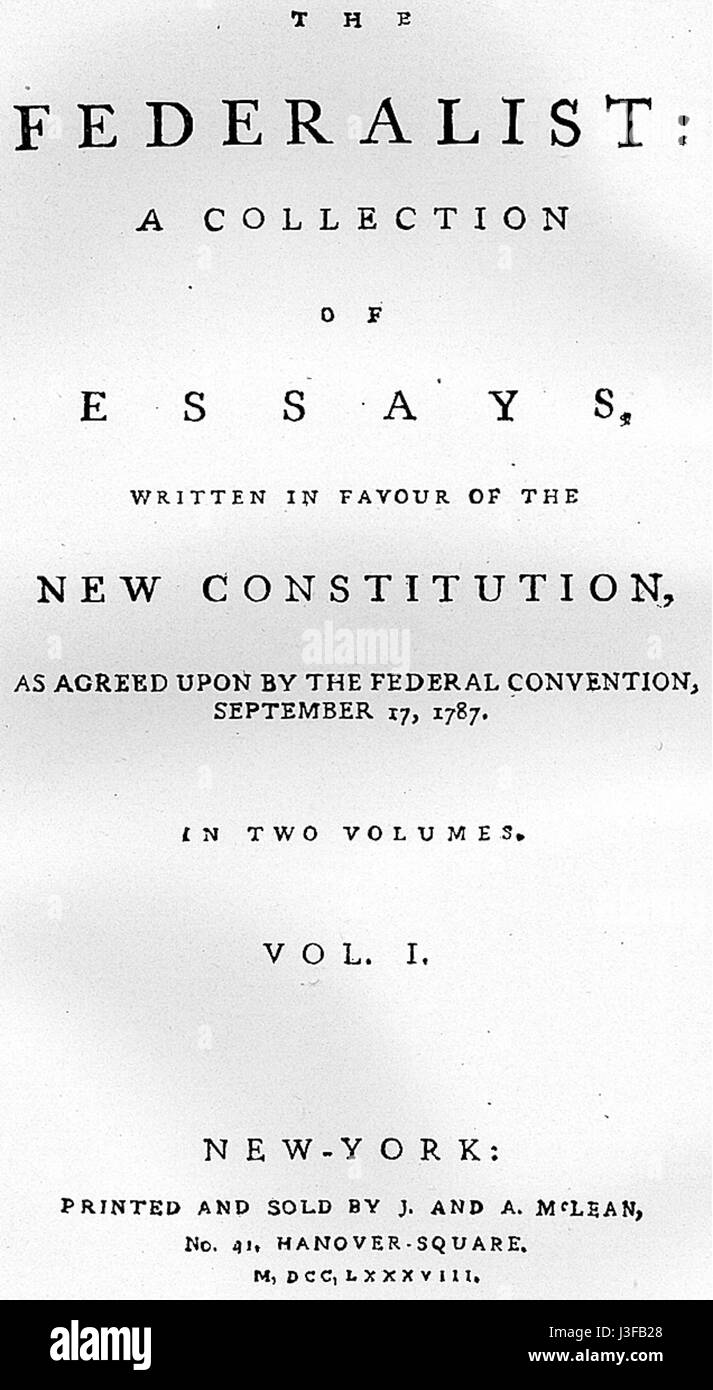
A voter in Georgia might know almost nothing about a candidate from Massachusetts. A farmer in Pennsylvania would have limited information about a politician from South Carolina. Without modern communications, many delegates questioned whether voters could make informed decisions in a nationwide election. Some also feared what they called faction—organized political groups pursuing their own interests at the expense of the public good. Others worried about demagogues, charismatic leaders capable of inflaming public passions and accumulating dangerous amounts of power. Having recently fought a revolution against a king, the delegates had little interest in creating a system that might allow another form of tyranny to emerge. Not all of the delegates viewed these concerns in exactly the same way, but many shared a skepticism of pure direct democracy. Among the strongest defenders of the Electoral College was Alexander Hamilton. Writing in Federalist No. 68, Hamilton argued that the system would help protect the nation from foreign influence, political intrigue, and the dangers of elevating an unqualified candidate through temporary popular passions. Hamilton viewed the Electoral College as a stabilizing mechanism that balanced popular participation with an additional layer of deliberation. While acknowledging that no system was perfect, he expressed confidence in the one ultimately adopted, writing: "I venture somewhat further, and hesitate not to affirm that if the manner of it be not perfect, it is at least excellent."
To Hamilton, the Electoral College was not merely a compromise. It was one of the Constitution's strengths, helping to ensure that the presidency would be filled by individuals possessing the qualifications and judgment necessary for the office. Not everyone shared Hamilton's confidence in insulating presidential selection from direct public influence. James Wilson of Pennsylvania, one of the most influential delegates at the Constitutional Convention, favored a far more democratic approach. Wilson argued that the president should be elected directly by the people, believing that legitimacy flowed from popular consent rather than intermediary bodies. Wilson's proposal ultimately failed to gain sufficient support, but his position reveals an important reality often lost in modern discussions. The Founders were not united behind a single vision of how democracy or republican government should function. They disagreed about how much power ordinary citizens should exercise directly, how much authority should remain with the states, and how best to balance popular participation against the risks they perceived in majority rule. The Electoral College emerged not because every delegate believed it was the ideal system, but because it represented a compromise among competing visions of republican government. If direct election worried many delegates, allowing Congress to choose the president created a different set of problems.
The new Constitution was being built upon the principle of separated powers. The president would be expected to check Congress, just as Congress would check the president. If Congress selected the executive, could that executive truly remain independent? Would a president chosen by legislators feel obligated to those who put him in office? Might the office become little more than an extension of Congress itself? Many delegates also had the benefit—and perhaps the danger—of imagining George Washington occupying the office they were creating. While they sought to build institutions that would endure beyond any one individual, the presence of a universally respected national figure likely influenced how some delegates thought about executive power. The delegates also had to balance the interests of large states and small states. Larger states generally favored systems that reflected population. Smaller states feared being permanently overshadowed by their larger neighbors. Maintaining the support of both groups was essential if the Constitution was to be ratified and the Union preserved. Complicating every discussion was an issue that hovered over nearly every major debate of the Constitutional Convention: slavery.
This was not a new problem. The contradiction between America's ideals and the institution of slavery had existed since the nation's founding. During the drafting of the Declaration of Independence, Thomas Jefferson included language condemning the slave trade, only to see those passages removed in order to maintain support from colonies where slavery remained deeply entrenched. Even before independence was declared, the new nation was already confronting a difficult reality: lofty principles could unite Americans, but those same principles often collided with powerful political and economic interests. As with representation in Congress, the question of presidential selection would prove impossible to separate from the nation's deepest contradiction. The nation proclaimed ideals of liberty and self-government, yet hundreds of thousands of enslaved people lived within its borders. Southern states contained large populations of people who could not vote but whose existence affected questions of representation and political power. Delegates understood that any system based entirely on voting populations would produce different political outcomes than one that considered total population. As a result, debates about executive selection became entangled with the broader conflict over slavery and representation. By the summer of 1787, the delegates were attempting to solve multiple problems at the same time.
They wanted a president strong enough to govern but not strong enough to become a king. They wanted democratic legitimacy without creating what they viewed as the dangers of unchecked majority rule. They wanted an executive independent from Congress while still accountable to the public. They wanted a system acceptable to both large states and small states. And they wanted to hold together a union already divided by competing economic interests, regional loyalties, and the unresolved issue of slavery. No single proposal could satisfy all of these concerns.
The challenge facing the Constitutional Convention was not simply how to elect a president. It was how to balance competing principles, competing interests, and competing visions of what the new nation should become. Direct election ultimately lost out not because the delegates agreed on a better alternative, but because they could not agree on a single solution. Concerns about democracy, federalism, executive independence, regional power, and slavery all pulled the Convention in different directions. The solution they ultimately adopted would become known as the Electoral College—a compromise born not from consensus, but from disagreement.

Part II: The Compromise – How the Electoral College Was Born
No One Could Agree
If Part I demonstrated anything, it is this: there was no obvious answer to the question of how a president should be chosen. By the summer of 1787, the delegates had spent weeks debating a variety of proposals, each of which appeared to solve one problem while creating another. A direct popular vote promised democratic legitimacy, but many delegates worried that voters would lack sufficient information to make informed choices in a nation as large and geographically dispersed as the United States. Allowing Congress to choose the president threatened the principle of separated powers and raised concerns that the executive would become dependent upon the legislative branch. Selection by state legislatures preserved state influence but weakened the president's connection to the people. Other proposals—including selection by governors or specially appointed electors—likewise attracted supporters while raising new objections. Every proposal seemed to satisfy one group while alarming another. This was not simply a disagreement over procedure. It reflected fundamentally different ideas about how a republic should function. Some delegates believed the people should play the central role in choosing their leaders. Others believed popular opinion should be filtered through institutions capable of exercising independent judgment. Large states and small states viewed the problem differently. Northern and Southern states viewed it differently still. The challenge was no longer finding the perfect system. It was finding one that enough delegates could accept. As the debates continued, however, another issue increasingly shaped the conversation. It was the same issue that had complicated the Declaration of Independence, influenced representation in Congress, and hovered over nearly every major debate of the Constitutional Convention. Slavery.
There was one proposal that seemed almost self-evident. If the people were sovereign, why not simply allow them to choose their president directly?
To many modern Americans, that question appears to have an obvious answer. Yet to the delegates gathered in Philadelphia, it was anything but obvious. While some, including James Wilson, favored direct election, others recognized that a nationwide popular vote would produce political consequences extending far beyond the mechanics of counting ballots. James Madison, however, pointed out a problem that fundamentally changed the conversation. Madison acknowledged that a direct popular vote possessed an obvious democratic appeal. Yet he also recognized that the United States of 1787 was not a nation in which political power was distributed equally. The institution of slavery had already shaped debates over representation in Congress, and Madison understood that it would inevitably shape the debate over presidential elections as well. At first glance, direct election appeared to be the most democratic solution. If the people were the ultimate source of political authority, why not simply allow them to vote directly for the nation's chief executive? James Madison, however, identified a political reality that many delegates understood but few expressed so directly. During the Constitutional Convention, Madison observed:
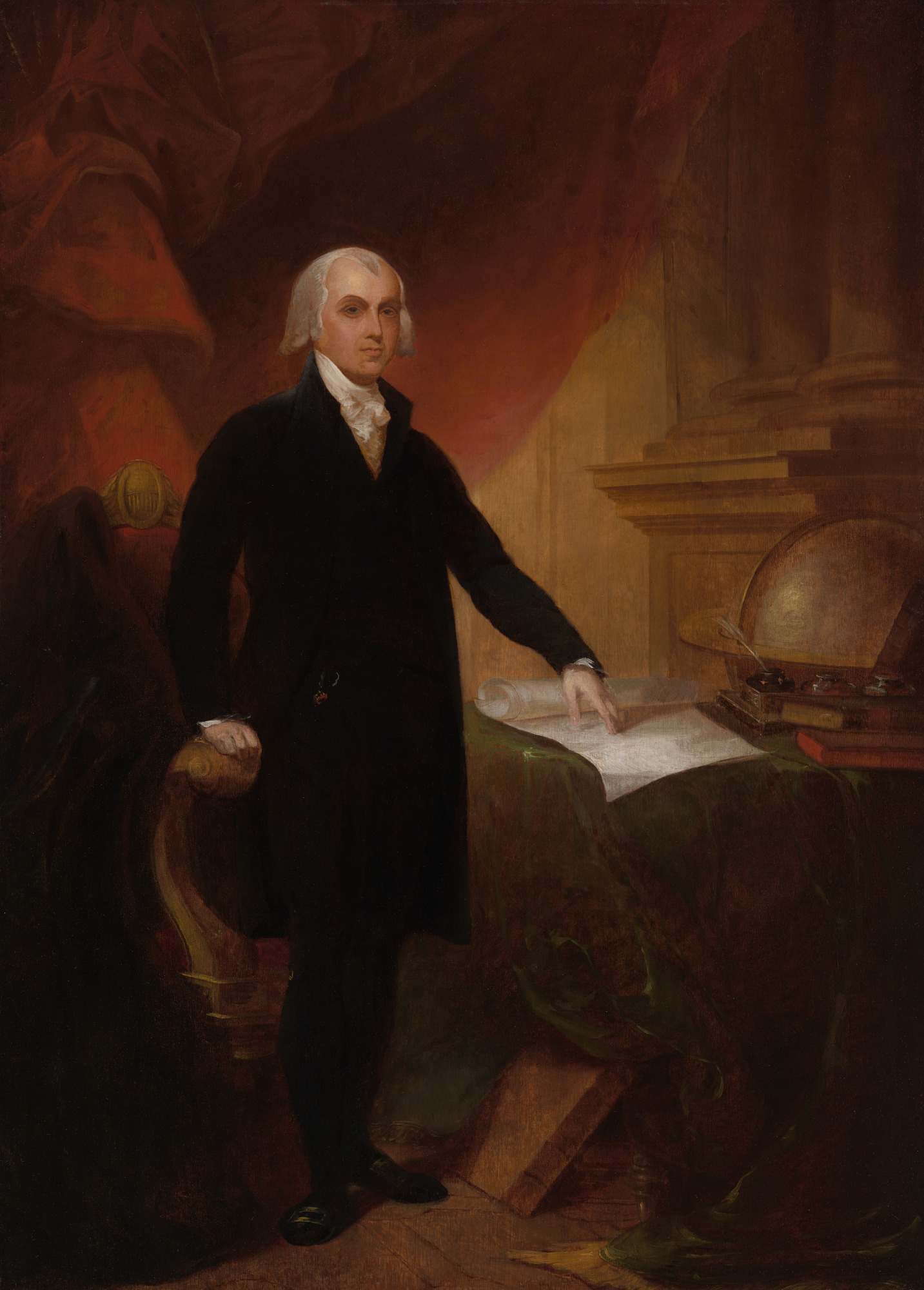
"The right of suffrage was much more diffusive in the Northern than the Southern States; and the latter could have no influence in the election on the score of the Negroes."
Few statements from the Constitutional Convention illustrate more clearly the extent to which slavery influenced the debate over how the President should be chosen. Madison was not making a moral defense of slavery. He was describing the political realities confronting the Convention. Northern states generally had larger voting populations, while Southern states contained hundreds of thousands of enslaved people who had no political rights. Under a direct popular vote, only actual voters would count. Southern delegates understood that such a system would significantly reduce their influence in presidential elections, making it far less likely that they would support the new Constitution. Representation in the House of Representatives was based on population. Through the Three-Fifths Compromise, enslaved people—though denied every political right, including the right to vote—were nevertheless counted as three-fifths of a person when determining representation in Congress. That compromise did more than determine the size of each state's congressional delegation. It also helped determine who would become President. Because each state's electoral votes equal its total representation in Congress—its members of the House plus its two Senators—additional seats in the House meant additional electoral votes. In effect, the constitutional compromise that increased Southern representation in Congress also increased Southern influence in presidential elections. The two issues were inseparable. In practical terms, Southern states gained additional influence in presidential elections because of populations that had no ability to participate in those elections. Under a direct national popular vote, that advantage would disappear almost overnight. Only actual voters would count. For Southern delegates, this was not merely a debate over election procedures. It was a debate over political power, regional influence, and the future balance of the Union itself. The Price of Compromise
The Price of Compromise
By the close of the Constitutional Convention, the delegates had accomplished something remarkable. Against enormous political, regional, and philosophical differences, they had produced a Constitution capable of winning the support of enough states to create a new nation. The Electoral College was one part of that broader achievement. It was not the product of a single principle, nor was it the unanimous preference of the Convention. Rather, it emerged because it addressed enough competing concerns to become politically acceptable. It preserved a role for the people while avoiding a direct national election. It protected the independence of the executive from Congress. It balanced the interests of large and small states. And, through its connection to congressional representation, it preserved Southern political influence in a nation still deeply divided by slavery. Like many constitutional compromises, it solved an immediate political problem without permanently resolving the deeper conflict beneath it. Compromise is often celebrated as one of democracy's greatest virtues. Without compromise, the Constitution itself likely would never have been written. Yet compromise also carries risks. It can postpone conflict without resolving it. It can preserve political unity while leaving deeper moral questions unanswered. The Electoral College reflected both the strengths and the limitations of constitutional compromise. For a time, it was enough to preserve the Union. It would not be enough to resolve the questions the Union had chosen to postpone.
“The Electoral College was built for a different America.”HIGHER IDEALS
Part III —The Electoral College the Founders Never Expected
A System That Changed Almost Immediately
If the delegates who left Philadelphia in 1787 believed they had permanently solved the problem of presidential elections, history quickly proved otherwise. The Electoral College described in the Constitution would remain on paper, but the way it actually functioned began changing almost immediately.
The Founders had designed a system for a nation without organized political parties. They envisioned electors as independent citizens who would exercise their own judgment when selecting the President. That vision, however, collided with political reality.
Within little more than a decade, the Electoral College was already operating very differently than many of its architects had anticipated.
The institution Americans debate today is therefore not simply the Electoral College created in 1787. It is the product of more than two centuries of constitutional amendments, political innovation, and evolving democratic practice.
The Founders Didn't Plan for Political Parties
The Constitution never mentions political parties. That omission was no accident. Today, it is almost impossible to imagine American politics without Democrats and Republicans. Political parties organize elections, nominate candidates, shape legislation, and influence nearly every aspect of our political system. Yet in 1787, many of the men gathered in Philadelphia hoped permanent political parties would never become a defining feature of the American republic.
Their concerns were rooted in both history and philosophy. The Founders believed republics rarely collapsed because of foreign invasion alone. More often, they believed free governments were weakened from within—by orruption, factionalism, and citizens placing personal or regional interests above the common good.
The Founders were students of history, particularly the ancient republics of Greece and Rome. They had seen how political factions could divide nations, encourage corruption, and ultimately destroy republican government from within. Just as importantly, they were products of the Enlightenment, an intellectual movement that placed tremendous faith in reason, civic virtue, and the ability of educated citizens to pursue the common good over personal interest.
James Madison devoted the entirety of Federalist No. 10 to what he called "factions." By factions, Madison meant groups of citizens united by common interests or passions that could threaten the rights of others or the public good. Importantly, Madison did not believe factions could ever be eliminated. To do so would require destroying liberty itself. Instead, he argued that the Constitution should be designed to limit the damage factions could cause by dispersing political power across a large republic.
George Washington shared many of these concerns. In his Farewell Address, he warned future generations that organized political parties could encourage citizens to place loyalty to party above loyalty to country, inflame regional divisions, invite foreign influence, and gradually weaken the Union itself. Washington warned that political parties could eventually substitute the interests of party for the interests of the nation itself. As he wrote:
“serve to organize faction, to give it an artificial and extraordinary force—to put in the place of the delegated will of the nation the will of a party"
He continued by warning that political parties could become:
"potent engines, by which cunning, ambitious, and unprincipled men will be enabled to subvert the power of the people."
Washington's warning was not simply about politicians arguing with one another. He feared that permanent political parties would fundamentally alter the incentives of republican government. If public officials became primarily accountable to party organizations rather than to the nation as a whole, constitutional institutions designed to encourage independent judgment could instead become instruments of partisan competition. Whether Washington's fears were fully justified remains open to debate. What is beyond dispute, however, is that political parties would reshape nearly every institution created in 1787—including the Electoral College.
The Electoral College reflected those assumptions.
Ironically, many of the very men who feared permanent political parties—including Alexander Hamilton, Thomas Jefferson, James Madison, and John Adams—would soon become the leaders of America's first organized political movements. The Constitution was barely a decade old before political reality began reshaping the system its architects had so carefully designed.
Rather than functioning as representatives of political parties, presidential electors were expected to exercise independent judgment. They would evaluate the qualifications, experience, and character of potential candidates before casting their votes. Alexander Hamilton described this vision in Federalist No. 68, arguing that the office of President should ultimately be entrusted to individuals chosen by "men most capable of analyzing the qualities adapted to the station." Hamilton envisioned electors acting less as representatives and more as deliberators—individuals capable of weighing the qualifications of potential presidents free from immediate political passions.
It was an elegant theory. It simply underestimated how quickly Americans would organize themselves into political parties.
The Election That Broke the Original Design
If the Constitutional Convention marked the birth of the Electoral College, the election of 1800 represented its first major crisis.
The original Constitution required each presidential elector to cast two votes for President. The candidate receiving the greatest number of electoral votes would become President, while the runner-up would become Vice President. The system assumed electors would exercise independent judgment rather than coordinate as members of political parties.
Reality unfolded very differently, and organized political parties quickly emerged. By the election of 1800, organized political parties had emerged with remarkable speed. The Federalists supported President John Adams, while the Democratic-Republicans rallied behind Thomas Jefferson. Rather than acting independently, electors increasingly voted according to carefully coordinated party strategy. That strategy unexpectedly produced a constitutional crisis.
For the first time, the House of Representatives was forced to choose the President. Because every Democratic-Republican elector cast one vote for Thomas Jefferson and one vote for Aaron Burr, both men finished with seventy-three electoral votes. Under the Constitution, the tie forced the election into the House of Representatives. What followed was one of the most dramatic moments in early American political history.
For six days, the House balloted thirty-six separate times without producing a winner. Federalists, unwilling to support Jefferson, considered backing Burr despite his having been Jefferson's intended running mate. Alexander Hamilton, despite years of bitter political rivalry with Jefferson, viewed Burr as the more dangerous man and ultimately urged fellow Federalists to support Jefferson instead.
After thirty-six ballots—and only after intense political maneuvering—Thomas Jefferson was finally elected President.
The crisis revealed something profoundly important. The crisis demonstrated that the Electoral College had not failed because the Constitution had been ignored. It failed because political reality had changed faster than the Constitution anticipated. It had broken because the assumptions upon which it had been designed no longer reflected political reality. Human nature had adapted faster than the Constitution.
The Twelfth Amendment
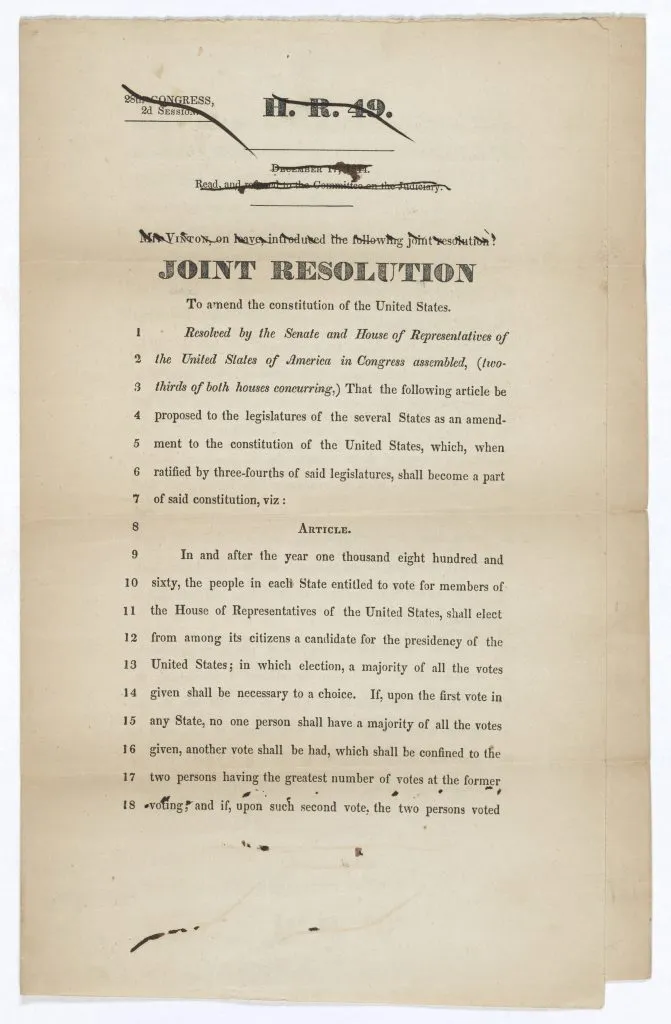
The constitutional response came quickly. Only four years after the election of 1800, Congress proposed what would become the Twelfth Amendment. Ratified in 1804, the amendment fundamentally changed the Electoral College by requiring electors to cast separate votes for President and Vice President.
On the surface, the amendment appeared modest. In reality, it represented an extraordinary acknowledgment that one of the Constitution's most carefully debated institutions had already required significant revision. The amendment did not eliminate the Electoral College. Instead, it accepted a political reality that many of the Founders had hoped to avoid: political parties were now a permanent feature of American democracy. This is an important point that is often overlooked.
The Electoral College Americans discuss today is not identical to the Electoral College debated in Philadelphia during the summer of 1787. The Constitution's original design survived for barely a decade before political experience forced its first major revision. That fact does not necessarily prove the Electoral College was a failure. It does, however, remind us that even the Founders themselves expected future generations to learn from experience and adapt when necessary.
Why the Twelfth Amendment Matters
The Twelfth Amendment did more than correct a flaw exposed by the election of 1800. It acknowledged something much larger.
The Founders had attempted to design a constitutional system insulated from permanent political parties. Experience demonstrated that assumption was unrealistic. Rather than attempting to eliminate parties, the amendment quietly accepted that they had become a permanent feature of American politics. That realization carries an important lesson extending far beyond presidential elections. Constitutions are written on paper. Politics is practiced by people. The two are not always the same.
No matter how carefully institutions are designed, they ultimately operate within a society composed of ambitious individuals, competing interests, and changing political realities. Rules influence behavior, but behavior also reshapes institutions.
The Twelfth Amendment serves as one of the earliest reminders that constitutional government is not static. It evolves—not because the Constitution itself constantly changes, but because the people operating within it do.
That raises an interesting question. If one of the Constitution's most carefully debated institutions required revision after only thirteen years, what does that tell us about the relationship between constitutional design and political reality?
Ironically, the Twelfth Amendment did not restore the Electoral College to the independent deliberative body Hamilton envisioned. It did the opposite. By formally recognizing separate presidential and vice-presidential tickets, the amendment effectively acknowledged that political parties had become an enduring feature of American elections. Rather than resisting that reality, the Constitution adapted to it. The Electoral College survived. Its original assumptions did not.
An Institution That Never Stopped Evolving
The Twelfth Amendment was only the beginning. Although the Constitution has changed relatively little since 1787, the operation of the Electoral College has continued to evolve in ways the Founders almost certainly could not have anticipated. Perhaps the most significant change was the widespread adoption of winner-take-all elections. Contrary to popular belief, the Constitution does not require states to award all of their electoral votes to the candidate receiving the most votes statewide. That practice developed gradually through state law as political parties recognized the strategic advantages it provided. Today, only Maine and Nebraska allocate electoral votes differently.
Campaign strategy evolved as well. Modern presidential campaigns devote enormous attention and financial resources to a relatively small number of competitive swing states while safely Republican and safely Democratic states often receive comparatively little attention. Candidates spend months campaigning in Pennsylvania, Michigan, Wisconsin, Arizona, and Georgia while rarely visiting states whose outcomes are considered virtually certain.
The role of presidential electors also changed dramatically. Rather than serving as independent decision-makers carefully evaluating competing candidates, electors today almost always function as loyal representatives of their political parties. Although so-called "faithless electors" occasionally receive public attention, they remain exceptionally rare. The deliberative body envisioned by Hamilton has largely become a formal mechanism for certifying decisions already made by voters and political parties.
Taken together, these developments illustrate an important reality about constitutional government. Institutions do not remain frozen in time. They evolve. Sometimes they evolve through constitutional amendments. Sometimes through legislation. Sometimes through judicial interpretation. And sometimes simply because human beings adapt to the incentives created by existing institutions.
The Electoral College is perhaps one of the clearest examples of this process in American constitutional history. The Constitution established the framework. Politics transformed how that framework actually operated.
By the dawn of the twenty-first century, nearly every assumption that shaped the debates of 1787 had changed. The nation was larger, more connected, and more democratic. Political parties had become permanent institutions. Slavery had been abolished. Women could vote. Mass communication made nationwide campaigns possible. Yet the constitutional framework for electing a president remained largely recognizable. The institution endured. The nation changed around it.
The Founders' Problem...Our Debate
More than two centuries have passed since delegates gathered in Philadelphia to design a new system for choosing a President. The America they knew no longer exists. A nation of fewer than four million people has become one of more than three hundred million. Horseback and handwritten letters have given way to airplanes, television, smartphones, and instantaneous communication. Political parties—once feared by many of the Founders—have become central institutions of American democracy. Slavery, which shaped so much of the Constitutional Convention's debate over presidential elections, has been abolished. Women gained the right to vote. Constitutional amendments and civil rights legislation have expanded the electorate far beyond what most delegates in 1787 could have imagined.
In many respects, the United States solved problems the Founders never anticipated while outgrowing many of the assumptions upon which the Electoral College was originally built. Yet remarkably, the questions confronting Americans today are strikingly similar to those confronting the delegates in Philadelphia. How much influence should the people exercise directly? How should the interests of large and small states be balanced? Can democratic participation coexist with political stability? Can institutions designed for one generation continue to serve another? Those questions are no longer the Founders' problem. They are ours.
Compromise or trade-offs?
For much of this article, we have described the Electoral College as a product of compromise. That is certainly true.
The delegates compromised with one another. Large states and small states compromised. Delegates disagreed over executive independence, popular participation, the balance between state and national authority, and the ever-present issue of slavery. Again and again, they searched for arrangements that enough people could accept—even if no one believed they had found a perfect solution.
Without compromise, the Constitution itself almost certainly would never have been written. Yet history invites us to look at those decisions from another perspective. Viewed from a greater historical distance, another word begins to emerge. Viewed from more than two centuries of hindsight, perhaps "compromise" is only part of the story. Perhaps another word better describes what the delegates were really doing. Trade-offs.
The Convention repeatedly chose between competing constitutional principles. The delegates were rarely deciding between an obvious right and an obvious wrong. More often, they were deciding which principle deserved greater weight under the circumstances they faced.
They accepted limits on direct democracy in exchange for what they believed would be greater political stability. They accepted a more complicated electoral system in an effort to preserve both popular participation and the federal character of the Union. Most controversially of all, they accepted continued compromises with slavery in the hope of preserving a nation they feared might not survive. Those were trade-offs. Whether they made the correct ones is another question.
Every constitutional system involves them. Protecting one principle often requires limiting another. Expanding one value may require accepting costs somewhere else. Governments rarely choose between good and bad options. More often, they choose between competing goods—each carrying its own benefits, costs, and unintended consequences. The Constitutional Convention was filled with those choices. The delegates traded a more direct form of democracy for a system they believed would produce greater political stability. They traded speed for deliberation. They traded simplicity for federalism. Most controversially, they traded immediate justice on the question of slavery for what they hoped would be a stronger and more durable Union.
The Electoral College is hardly unique in this respect. Throughout American history, moments of constitutional change have repeatedly forced Americans to choose between competing principles rather than between obvious right and obvious wrong.
Whether those trade-offs were wise remains a matter of debate. What cannot be debated is that they existed. Nor can it be debated that every one of those choices produced consequences extending far beyond the summer of 1787. Some strengthened the new republic. Others postponed conflicts that future generations would eventually be forced to confront.
History rarely allows us to keep the benefits of difficult decisions without eventually confronting their costs. Perhaps that is the deeper lesson of the Electoral College. It is not merely a story about compromise. It is a case study in the difficult trade-offs that every constitutional democracy must eventually make.
Perhaps that is the deeper lesson of the Electoral College. Its history is not merely the story of one constitutional institution. It is the story of how free people attempt to govern themselves despite profound disagreements. The specific issues change. The difficult choices do not.
The Electoral College is only one example. Throughout American history Americans have repeatedly confronted the same fundamental challenge: how should a free people balance competing ideals when every available choice carries consequences? Later articles will examine those questions from different moments in our history. Again and again throughout American history, our greatest political debates have not been contests between right and wrong, but between competing ideals—liberty and security, equality and federalism, stability and reform. The challenge has never been avoiding those choices. It has been making them wisely.
The question, then, is no longer whether the Founders compromised. They did. The question is not whether every constitutional system involves trade-offs. They do. The more difficult questions—and the ones every generation must eventually answer—are whether the trade-offs they accepted remain justified, and if not where to go now?
From History to Judgment
Everything we have examined so far explains why the Electoral College was created, why it changed, and why it still exists. It does not answer whether it should. History rarely provides policy prescriptions. Instead, it provides something perhaps even more valuable: context.
Understanding why previous generations made particular choices does not automatically tell us what the current generation should do. Circumstances change. Institutions evolve. New problems emerge while old ones disappear.
By the beginning of the twenty-first century, Americans found themselves debating an institution that looked remarkably different from the one designed in Philadelphia more than two centuries earlier. Yet many of the questions confronting the Founders remain surprisingly familiar. How should the people choose their President? How should the interests of large and small states be balanced? Can democratic participation coexist with political stability?
And perhaps most importantly…
If an institution has evolved far beyond its original design, should it continue to be judged by the problems it solved in 1787—or by the way it functions today? History cannot make today's decision for us. It can, however, ensure that we ask better questions.
If the Electoral College no longer functions as many of its architects envisioned, should it nevertheless be preserved because it continues to serve important constitutional purposes? Or should an institution be judged not by the problems it solved in 1787, but by the incentives and outcomes it creates today?
Answering those questions requires us to leave eighteenth-century Philadelphia behind and examine the Electoral College as it exists in modern America. The purpose of history is not to relieve us of difficult decisions. It is to ensure that when we make them, we understand the choices that came before us—and the consequences that followed.
Every generation inherits institutions created by those who came before it, then faces the same difficult question: preserve them, reform them, or replace them. That question confronted the delegates in Philadelphia. It confronted the nation after the Civil War. It confronted Americans during the Progressive Era and the Civil Rights Movement. And it confronts us today. The Electoral College is only one example. History explains why institutions exist. Citizenship requires us to decide what to do with them. That responsibility cannot be delegated to the Founders. It belongs to us.
Part IV - An Institution Built for a Different America?
The Geography of Presidential Politics
"Institutions do more than determine outcomes. They shape behavior."
For much of this article, we have examined why the Electoral College was created and how it evolved. Yet institutions are ultimately judged not only by their origins, but by the incentives they create. The Electoral College does more than determine who becomes President of the United States. It also influences how presidential campaigns are conducted, where candidates spend their time, where political parties invest their resources, and which voters receive the greatest attention.Modern campaigns do not compete everywhere. They compete where the incentives lead them.
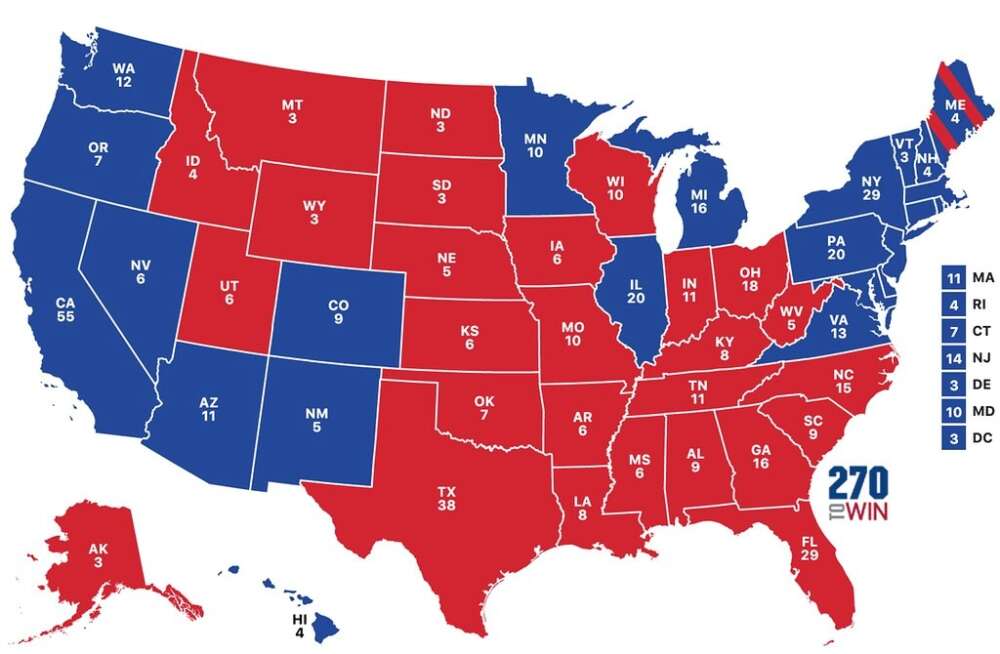
The results are striking. Rather than distributing time evenly across the nation, campaigns overwhelmingly concentrated their efforts in a handful of closely contested battleground states. Pennsylvania alone received 47 campaign visits. Florida received 31. North Carolina received 25. Michigan received 21.
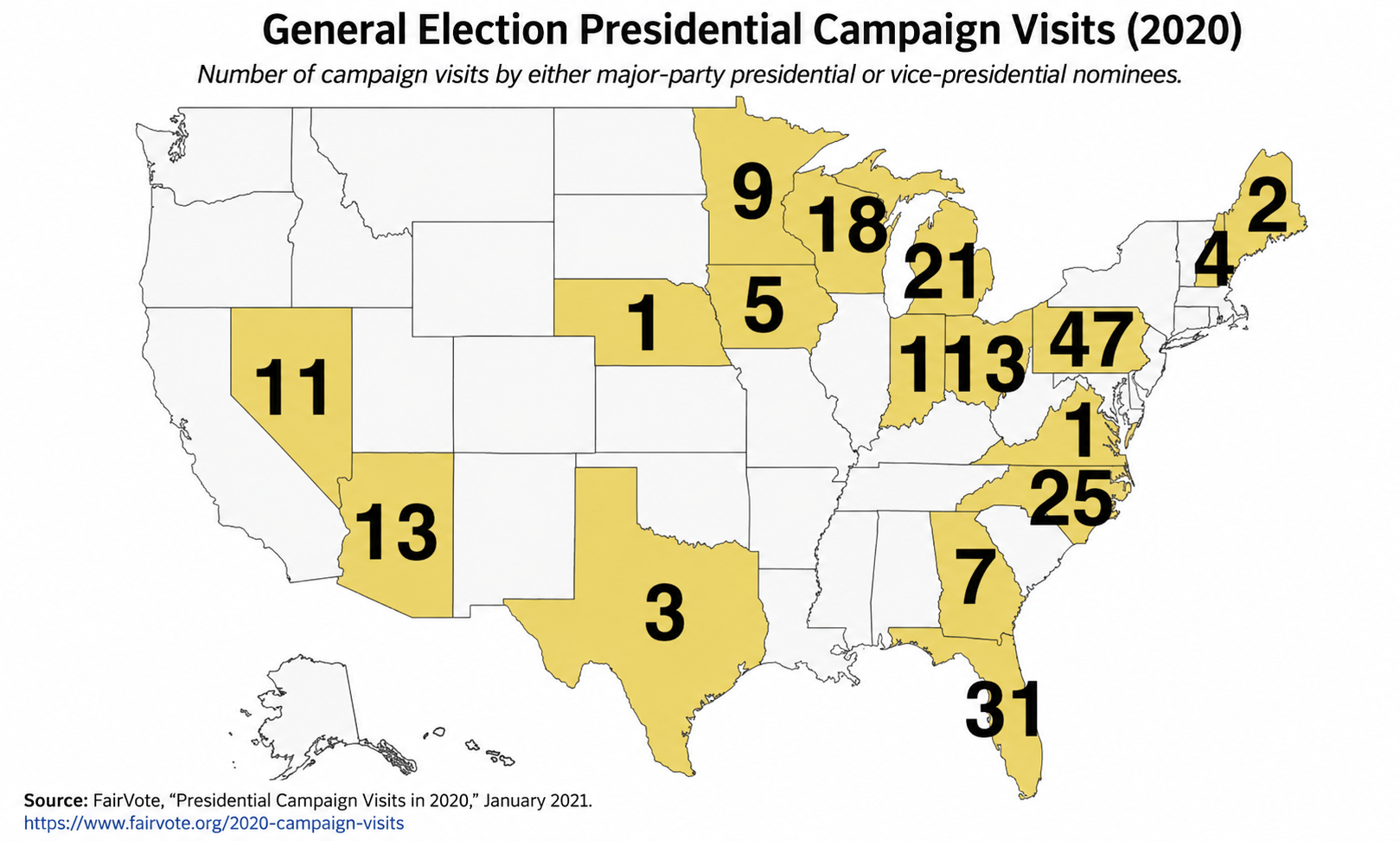
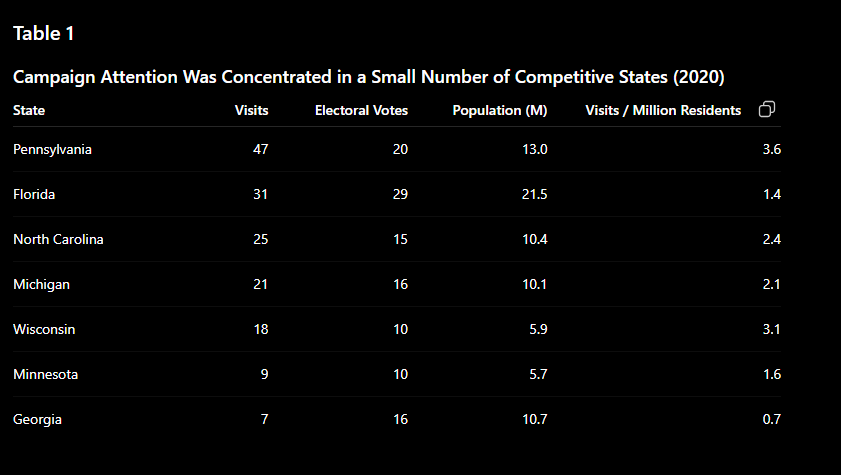
Meanwhile, dozens of states—including several of the nation's most populous—received little or no campaign attention. This outcome is neither accidental nor necessarily evidence of unfairness.
It is the predictable result of incentives. Under the winner-take-all system used by nearly every state, campaigns maximize their chances of victory by concentrating resources where relatively small changes in voter behavior can produce large electoral rewards. The Electoral College therefore shapes far more than election night. It shapes the campaign itself.
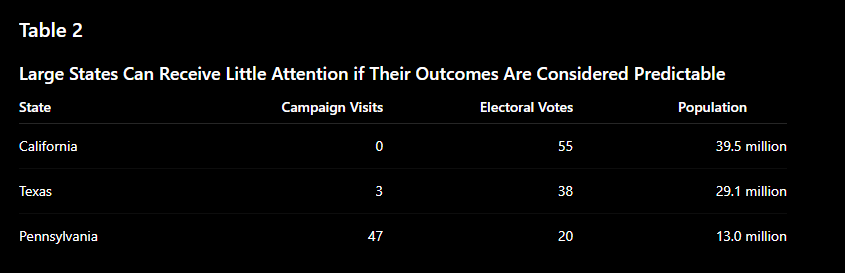
The contrast is difficult to ignore. California possessed the largest number of electoral votes in the nation and nearly forty million residents. Yet neither campaign considered it a worthwhile investment. Pennsylvania, with roughly one-third California's population and far fewer electoral votes, became the center of the presidential campaign. The explanation lies not in size. It lies in predictability.
Now the incentive becomes clear. Campaigns are not merely seeking electoral votes. They are seeking competitive electoral votes. Every additional advertisement, rally, candidate visit, and volunteer hour is directed toward states where relatively small shifts in voter behavior can alter the outcome. States whose outcomes are already considered secure—whether safely Democratic or safely Republican—receive comparatively little attention because campaigns gain little strategic advantage by investing there. The Electoral College does not tell campaigns where they must compete. It tells them where competing is most likely to matter.
This raises an important question. If presidential campaigns naturally devote their greatest attention to a relatively small number of competitive states, is this concentration of resources a flaw in the Electoral College? Or is it evidence that the institution continues to function exactly as its incentives encourage?
The answer depends, once again, on how one evaluates the trade-offs. Some view this concentration as a distortion of democratic equality, arguing that voters in swing states receive disproportionate influence over presidential elections.
Others argue that requiring candidates to assemble geographically diverse coalitions—even if concentrated in competitive states—remains an important feature of American federalism. History alone cannot resolve that disagreement.
But it does explain why those incentives exist.
When the Popular Vote and the Electoral Vote Disagree
The concentration of campaign attention in a handful of competitive states leads naturally to another question.
Does the Electoral College always produce the same winner that a nationwide popular vote would? Most of the time, the answer is yes.
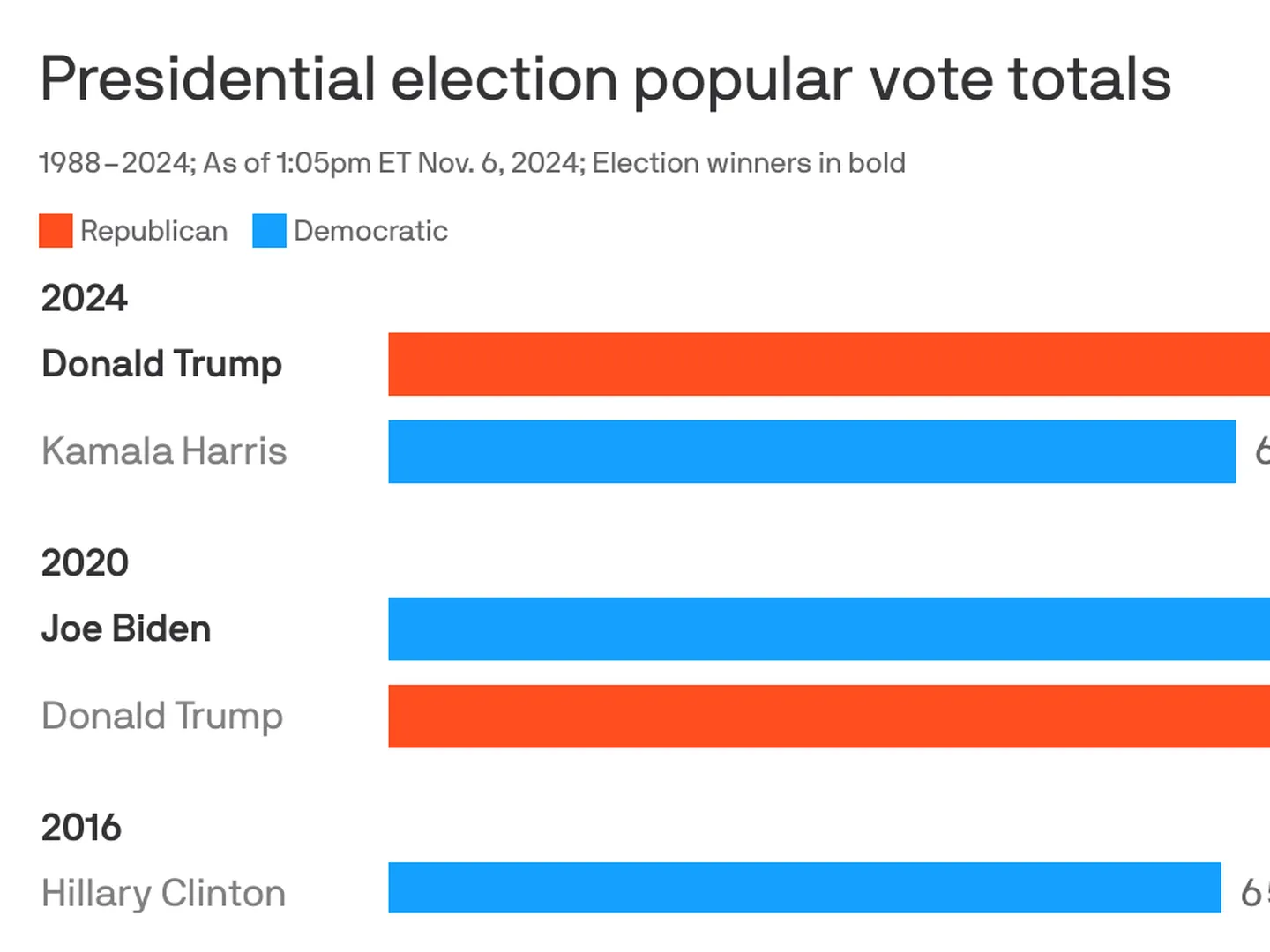
Throughout American history, the candidate winning the national popular vote has also won the Electoral College in the overwhelming majority of presidential elections. Yet on several occasions, the two have produced different outcomes. These elections have become some of the most controversial in American political history—not because the Electoral College malfunctioned, but because it functioned exactly as the Constitution intended.
The most widely known modern example occurred in the election of 2000. Vice President Al Gore received more votes nationwide than Governor George W. Bush, yet Bush ultimately secured a majority of electoral votes after a razor-thin and fiercely contested election in Florida. The ensuing recount, legal challenges, and Supreme Court decision transformed what had largely been an academic debate about the Electoral College into a national political controversy.
The debate returned sixteen years later. In 2016, Hillary Clinton received nearly three million more votes nationwide than Donald Trump. Yet Trump won narrow victories in several key battleground states, giving him an Electoral College majority and the presidency.
To critics, these elections expose one of the Electoral College's greatest weaknesses. They argue that the candidate receiving the most votes from the American people should become President and that any system producing a different result undermines democratic legitimacy.
Supporters view those same elections differently. They argue that the Constitution does not establish a single national election. Instead, it establishes fifty separate state elections whose results are combined through the Electoral College. Under that system, presidential candidates are required to assemble geographically broad coalitions rather than simply maximize their national vote totals. From this perspective, the Electoral College did not overturn the popular vote because there is no constitutional national popular vote to overturn.
The disagreement therefore reflects a deeper constitutional question. Should presidential elections primarily measure the will of individual voters across the nation as a whole? Or should they reflect the combined judgment of the states acting together within a federal republic? Like so many of the questions surrounding the Electoral College, the answer depends upon which constitutional principles one believes deserve the greatest weight.
The Electoral College's Defenders
Public debate surrounding the Electoral College often focuses on its shortcomings. Yet any serious evaluation requires examining not only the problems critics identify, but also the reasons many scholars, constitutional lawyers, and elected officials continue to defend it.
One of the most common arguments centers on the federal nature of the American system itself. Federalism intentionally disperses political power across multiple governments rather than concentrating authority in Washington. Supporters argue that requiring presidential candidates to build support across multiple states reflects that broader constitutional philosophy. The Electoral College therefore represents not merely an election system, but one expression of a federal republic built upon divided sovereignty. The United States is not simply one national electorate. It is a constitutional republic composed of fifty states, each possessing its own government, laws, and political identity.
That federal structure did not emerge by accident. The Constitution itself was written to replace the Articles of Confederation, which created a national government so weak that it lacked an independent executive altogether. Under the Articles, the states retained broad political authority while the national government depended largely upon their cooperation.
When the delegates met in Philadelphia in 1787, they sought to create a stronger national government without completely abandoning the federal character of the Union. The challenge was not simply deciding whether the United States should have a President. It was determining how a nation composed of individual states would collectively choose one.
The Electoral College reflected that solution. Rather than treating the presidency as the product of a single nationwide election, the Constitution gave each state responsibility for appointing presidential electors "in such Manner as the Legislature thereof may direct." The President would therefore be chosen through a process that combined national leadership with the federal character of the Union.
Supporters argue that this federal structure remains one of the Electoral College's greatest strengths. By requiring presidential candidates to assemble electoral majorities across multiple states rather than simply maximizing votes in a handful of densely populated regions, they contend the system reinforces the constitutional role of the states within the American republic.
Advocates also argue that the Electoral College encourages coalition-building. A successful presidential candidate must appeal to voters from different regions, industries, and political cultures. Rural communities, suburban voters, and urban populations all become part of the electoral equation. While no system guarantees equal campaign attention, supporters contend that requiring geographically distributed support discourages candidates from relying too heavily on any single region of the country.
Others point to political stability. Because nearly every state awards its electoral votes on a winner-take-all basis, close elections in one state rarely require nationwide recounts. Instead, disputes tend to remain confined to the states where the outcome is genuinely uncertain. Supporters argue that this feature provides clearer outcomes and reduces the likelihood that every close presidential election would result in fifty simultaneous recounts and legal challenges.
Some defenders also argue that the Electoral College contributes to the nation's long tradition of peaceful transfers of power. By producing decisive electoral vote totals even when the national popular vote is relatively close, the system often creates a clearer constitutional outcome than the underlying vote totals alone might suggest.
Whether these arguments remain persuasive is, of course, a matter of debate. Their importance lies elsewhere. They remind us that evaluating constitutional institutions requires more than identifying their flaws. It requires understanding the problems they were originally intended to solve.
They remind us that the Electoral College was not designed merely to count votes. It was designed to balance competing constitutional values. Even those who favor reform must first grapple with an important question:
If the Electoral College were abolished tomorrow, what constitutional principles would be lost along with it?
How Should We Judge Constitutional Institutions?
For much of this article, we have looked backward. We have examined why the Electoral College was created, why it evolved, and why thoughtful people continue to disagree about its value. Those questions are important. They are not, however, the final question.
The more difficult question is how constitutional institutions themselves should be judged. Should an institution be evaluated primarily by the intentions of those who created it? By the problems it originally solved? Or by the incentives and outcomes it produces today?
Those are not merely questions about the Electoral College. They are questions every generation inherits. The Constitution itself reflects this reality.
The Framers included an amendment process because they understood that no generation could perfectly anticipate the needs of every generation that followed. At the same time, they deliberately made amendment difficult because they believed stability carried value of its own.
The result is a constitutional system that encourages neither blind preservation nor constant change. Instead, it asks each generation to exercise judgment.
Thomas Jefferson once suggested that every generation should possess the authority to reconsider the institutions inherited from those who came before it. Whether Jefferson's proposed timetable of nineteen years is practical is beside the point. His larger observation remains remarkably relevant. Every generation inherits institutions it did not create. Every generation must decide whether to preserve them, reform them, or replace them. The Electoral College is simply one example of that broader responsibility.
History teaches that every institutional design involves trade-offs. The Electoral College is no exception. Preserving federalism may reduce electoral equality. Increasing electoral equality may diminish the constitutional role of the states. Expanding democratic participation may introduce new challenges to political stability. Protecting stability may leave some citizens feeling underrepresented. There is no institutional design without costs.
The question is not whether trade-offs exist. The question is whether the trade-offs we inherited remain the ones we are willing to accept.
The Electoral College's Critics
Public debate surrounding the Electoral College has grown considerably over the past several decades, particularly following presidential elections in which the Electoral College and the national popular vote produced different winners. While defenders emphasize the constitutional principles the system was designed to protect, critics argue that the institution now creates consequences that undermine democratic representation in ways the Founders could never have anticipated.
Perhaps the most common criticism concerns political equality. Under the Electoral College, every citizen casts one vote. Yet those votes do not always carry the same practical influence over the outcome of a presidential election. Because electoral votes are allocated by state rather than by a single national tally, a vote cast in a highly competitive battleground state is often viewed as more politically consequential than one cast in a state whose outcome is considered virtually certain.
The difference is not legal. Every eligible citizen receives one vote. The difference lies in political incentives.
Critics note that these incentives can produce demographic consequences as well as geographic ones. Because different racial, ethnic, and socioeconomic groups are not evenly distributed across the fifty states, the Electoral College may amplify or diminish the political influence of certain communities depending upon where they live. Highly urbanized populations, for example, are often concentrated in states whose presidential outcomes are considered relatively predictable, while smaller or less densely populated states receive proportionally greater attention during competitive elections. Critics argue that these geographic realities can create demographic disparities that were never explicitly intended by the Constitution but nevertheless shape modern presidential politics.
Some experts observe that every state receives two electoral votes corresponding to its representation in the Senate regardless of population. As a result, smaller states receive proportionally greater representation in the Electoral College than larger states. Although this feature reflects the constitutional compromise between large and small states reached in 1787, critics argue that it means individual votes do not carry identical weight across state lines.
Additionally, a voter in Pennsylvania or Wisconsin is far more likely to receive campaign visits, advertising, candidate attention, and policy discussion than a voter living in California, Texas, or New York during a competitive presidential election. Critics argue that while every vote is counted equally within each state, not every voter receives equal attention from those seeking the presidency.
Others point to the winner-take-all system used by forty-eight states and the District of Columbia. Although commonly associated with the Electoral College itself, winner-take-all allocation is largely a product of state law rather than constitutional requirement. Under this approach, a candidate winning a state by a single vote receives every electoral vote that state possesses. Millions of votes cast for the losing candidate therefore produce no electoral representation in the final presidential tally.
Critics argue that this system encourages campaigns to think strategically rather than nationally. Instead of attempting to persuade voters everywhere, campaigns concentrate their time and resources where relatively small shifts in public opinion can produce the greatest electoral benefit. As a result, issues particularly important to competitive states may receive disproportionate national attention, while concerns affecting reliably Democratic or reliably Republican states often receive less emphasis.
The incentives created by the Electoral College extend beyond where candidates campaign. Modern presidential campaigns devote enormous resources to identifying persuadable voters, mobilizing reliable supporters, and allocating time and money where those investments are most likely to affect the electoral outcome. Critics argue that these incentives have contributed to increasingly sophisticated campaign strategies focused less on persuading the nation as a whole and more on maximizing electoral advantage within a relatively small number of competitive states.
The Electoral College is only one of many institutions that shape political incentives. Campaign finance laws, congressional district boundaries, primary elections, and advances in political data analytics all influence how candidates seek office and how citizens experience democracy. Each deserves its own examination.
Critics also argue that the Electoral College not only influences where campaigns spend their resources, but also where citizens feel politically relevant. Voters living in safely Democratic or safely Republican states often receive comparatively little attention during presidential campaigns, regardless of the competitiveness of local elections. Over time, critics contend, this can create the perception that some Americans participate in presidential elections while others merely observe them.
Critics further argue that the Electoral College encourages campaigns to think less about winning the largest number of votes nationwide and more about maximizing electoral efficiency. Success often depends not upon persuading every voter, but upon persuading—or mobilizing—the right voters in the right places at the right time. As campaign technology has become increasingly sophisticated, those strategic calculations have become central to modern presidential politics.
Some critics also question whether the Electoral College continues to reflect the democratic values of a modern nation. The institution was created in an era before universal suffrage, before the direct election of Senators, before political parties became permanent institutions, and before modern communications made nationwide campaigning possible. The America for which the Electoral College was designed differed dramatically from the America that exists today.
For these critics, the central question is not whether the Electoral College made sense in 1787. It is whether it continues to produce desirable incentives in the twenty-first century. Like its defenders, critics are ultimately asking a constitutional question rather than simply a political one. Should institutions primarily preserve the federal structure established by the Constitution? Or should they evolve when the political and social conditions that originally justified them have fundamentally changed?
The Electoral College is simply one chapter in a much larger story about how political institutions shape democratic behavior.
Part V—The Choice Before Us
Reform Is Difficult by Design
By this point, one conclusion should be clear. Whether one supports preserving the Electoral College or replacing it altogether, meaningful change is not simple. Nor was it intended to be.
The Constitution was written to endure. While the Framers understood that future generations would confront problems they could not anticipate, they also believed constitutional stability possessed value of its own. They therefore created an amendment process deliberately more difficult than ordinary legislation. Fundamental changes to the nation's governing framework would require broad and lasting national consensus rather than temporary political majorities.
That principle remains one of the Constitution's defining characteristics. The Electoral College is not merely a federal statute that Congress may revise through ordinary legislation. It is part of the Constitution itself. Abolishing it through constitutional amendment would require overwhelming agreement among both Congress and the states—a level of consensus that has proven extraordinarily difficult throughout American history.
Recognizing that reality, reform efforts today generally follow two different paths. Some seek to amend the Constitution directly. Others attempt to work within the existing constitutional framework while changing how presidential elections function in practice.
Like the Electoral College itself, each approach involves its own trade-offs.
The Available Paths
Americans today have no shortage of proposals for reforming presidential elections. The question is not whether alternatives exist. The question is what each alternative gains—and what each requires us to give up.
Keeping the current Electoral College preserves the federal structure created in 1787 while continuing to encourage candidates to assemble geographically broad coalitions. Critics argue that doing so also preserves unequal campaign attention, occasional conflicts between the popular vote and Electoral College, and disproportionate influence for competitive states.
Allocating electoral votes proportionally within each state would more closely reflect how citizens actually vote while reducing the winner-take-all effect. At the same time, such a system could make it significantly more difficult for any candidate to achieve an Electoral College majority, increasing the likelihood that presidential elections would be decided in the House of Representatives.
The congressional district method, currently used by Maine and Nebraska, attempts to recognize political diversity within individual states rather than treating each state as politically uniform. Critics respond that because congressional districts themselves may be shaped through partisan redistricting, the method could allow district boundaries to exert even greater influence over presidential elections.
The National Popular Vote Interstate Compact attempts to guarantee that the presidency goes to the candidate receiving the most votes nationwide without formally abolishing the Electoral College. Supporters argue that it honors democratic equality while avoiding the difficult constitutional amendment process. Critics question both its constitutionality and its long-term political durability.
The most sweeping proposal—a constitutional amendment establishing direct national election of the President—would fundamentally redefine how Americans choose their chief executive. Supporters argue that every citizen's vote would finally carry equal weight nationwide. Opponents counter that such a change would diminish the constitutional role of the states and fundamentally alter the federal character of the American republic.
Each proposal solves genuine problems. Each creates new ones. There is no reform without trade-offs.
The Conversation Continues

What Kind of Democracy?
Beneath every argument surrounding the Electoral College lies a much deeper question. What, exactly, should a presidential election accomplish? Should the office of President simply belong to the candidate receiving the greatest number of individual votes nationwide? Or should presidential elections continue to reflect the federal structure established by the Constitution, requiring candidates to build support across a union of states rather than a single national electorate?
Reasonable people answer those questions differently. Some believe democratic equality should take precedence over every other consideration. Others believe preserving the constitutional balance between the states and the national government remains equally important. Neither position avoids trade-offs.
Both require choosing which constitutional principles deserve greater weight. That reality should remind us that debates over the Electoral College are not simply debates about election procedures. They are debates about competing visions of American democracy itself.
Lessons from the Electoral College
If the Electoral College teaches us anything, it is that constitutional institutions cannot be understood apart from the historical circumstances that produced them. The delegates who gathered in Philadelphia were not attempting to design a perfect government. They were attempting to preserve a fragile republic.
The solutions they adopted reflected the political realities, competing interests, and constitutional values of their own generation. History also reminds us that institutions rarely remain frozen in time.
Political parties emerged. The Constitution was amended. Campaigns changed. Technology transformed communication. Voters expanded the meaning of democratic participation. The Electoral College survived. America changed around it.
Perhaps the most enduring lesson is that institutions create incentives. Those incentives shape political behavior. Political behavior gradually reshapes institutions. The Electoral College Americans debate today is not identical to the one debated in 1787 because the nation surrounding it has evolved dramatically over the past two centuries.
Finally, the Electoral College reminds us that constitutional government is built upon trade-offs. Every institutional design strengthens some principles while limiting others. Every generation inherits both the benefits and the costs of decisions made by those who came before it. Understanding those trade-offs does not eliminate disagreement. It makes disagreement more informed.
For more than two centuries, Americans have debated whether the Electoral College remains the best method of selecting a President. Those debates often produce a familiar question: Should we keep it or abolish it? Yet that framing may be too simplistic. Throughout this article, we have seen that constitutional institutions are rarely judged by a single standard. They are judged by the competing principles they attempt to balance and the trade-offs they inevitably create.
If Americans conclude that the Electoral College should remain unchanged, they implicitly accept the trade-offs it produces today: the continued importance of swing states, the possibility of occasional differences between the popular vote and the Electoral College, and the preservation of the federal structure envisioned by the Constitution. If Americans conclude that reform is necessary, the question becomes considerably more complicated. Every proposed alternative creates its own trade-offs.
Several reform proposals illustrate those trade-offs, allocating electoral votes proportionally within each state. Supporters argue that such a system would more accurately reflect the preferences of each state's voters while reducing the winner-take-all effect. Critics counter that proportional allocation could make it substantially more difficult for any candidate to achieve an Electoral College majority, increasing the likelihood that presidential elections would be decided by the House of Representatives.
Others support the congressional district method currently used by Maine and Nebraska. Under this approach, one electoral vote is awarded to the winner of each congressional district, while the statewide winner receives the remaining two electoral votes. Supporters contend that this better reflects regional political diversity within each state. Critics respond that because congressional districts themselves may be shaped through partisan redistricting, the method could allow district boundaries to exert greater influence over presidential elections.
A Final Reflection
History cannot tell us whether the Electoral College should remain. History cannot tell us whether it should be reformed. History cannot tell us whether it should be abolished. Those decisions belong to the American people.
What history can do is something equally important. It can explain why previous generations made the choices they did. It can reveal the principles they attempted to balance. It can expose the trade-offs they accepted. And it can remind us that every constitutional decision carries consequences extending far beyond the generation that first makes it.
More than two centuries ago, delegates gathered in Philadelphia to answer a difficult constitutional question. Today, that question has become ours. Whether Americans ultimately choose to preserve the Electoral College, reform it, or replace it altogether, the responsibility is the same as it was in 1787.
Still others support the National Popular Vote Interstate Compact. Rather than abolishing the Electoral College through constitutional amendment, participating states agree to award their electoral votes to the winner of the national popular vote once enough states join the compact to reach an Electoral College majority. Supporters argue that this would ensure the presidency is awarded to the candidate receiving the most votes nationwide while preserving the Constitution's formal structure. Critics question both the compact's constitutionality and its long-term political stability.
The most direct alternative would be a constitutional amendment replacing the Electoral College with a nationwide popular vote. Such an amendment would fundamentally redefine how Americans choose their President. Supporters argue that it would fully embody the democratic principle of political equality. Opponents contend that it would weaken the federal character of presidential elections and fundamentally alter the relationship between the states and the national government.
Each proposal attempts to solve genuine problems. Each also creates new ones. That reality should not discourage reform. Nor should it discourage preserving existing institutions. It should encourage humility.
The delegates who gathered in Philadelphia in 1787 confronted a series of extraordinarily difficult constitutional questions. They did not produce a perfect system because no perfect constitutional system exists. They produced a government built upon competing principles, difficult compromises, and unavoidable trade-offs.
More than two centuries later, those same questions remain. Every generation inherits institutions it did not create. Every generation must decide whether to preserve them, reform them, or replace them.
History cannot tell us what we should choose today. But it can tell us what previous generations chose, why they chose it, and what consequences followed. Ignoring those lessons does not free us from history—it only increases the likelihood that we will repeat it.
The Electoral College is only one of many institutions that shape political incentives. Campaign finance laws, congressional district boundaries, primary elections, and advances in political data analytics all influence how candidates seek office and how citizens experience democracy. Each deserves careful examination.
The question, then, is no longer whether the Founders chose correctly for their time. It is whether we will choose wisely for ours. And perhaps the greatest lesson of the Electoral College is not whether it should survive, but that constitutional questions rarely stay answered forever.
Sources
The following primary sources, historical scholarship, government publications, and election data informed this article. Additional resources are included for readers who wish to explore the topic further.
Primary Sources
- United States Constitution (1787)
- Federalist No. 68 — Alexander Hamilton
- James Madison — Notes of Debates in the Federal Convention of 1787
- Twelfth Amendment
- Fourteenth Amendment
Historical Scholarship
- Joseph J. Ellis — American Creation
- Pauline Maier — Ratification
- Gordon S. Wood — The Creation of the American Republic
Government Sources
- National Archives
- Library of Congress
- Federal Election Commission
- Congressional Research Service
- National Conference of State Legislatures
Election Data
- 270toWin
- MIT Election Data & Science Lab
- National Popular Vote
Images
- Library of Congress
- National Archives
- Public Domain historical artwork
- Original photography © Edward A. Wilson